By Adelyn Ho, Staff Writer
From September 15th to October 15th, River Hill celebrates National Hispanic Heritage Month, celebrating the cultures of those from Spain and 19 other countries and territories– Mexico, Guatemala, Honduras, El Salvador, Nicaragua, Costa Rica, Panama, Colombia, Venezuela, Ecuador, Peru, Bolivia, Paraguay, Chile, Argentina, Uruguay, Cuba, Puerto Rico, and the Dominican Republic. At River Hill, the Hispanic population was excited to share their traditions with the school during the annual Hispanic Heritage Assembly.
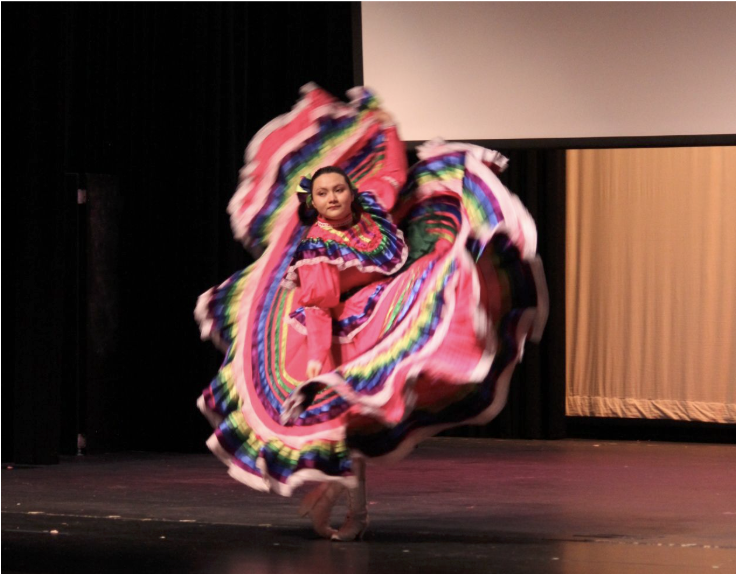
This assembly took place on September 30th, including dance performances and cultural showcases such as traditional folk dance. Brisa Leon-Martinez, a senior dancer representing Mexico in the assembly, shares that she feels “appreciated… I think the crowd likes all the colors and the high energy [of the assembly].” The assembly is flamboyant and colorful, presenting a variety of Hispanic cultures other than just Mexico or Spain. Leon-Martinez illustrates that “every single country in Latin America has a lot of variety when it comes to dance, outfits, and culture, and I think the assembly is a good way to share my culture with the rest of the school.” During the assembly, educational slides cover a variety of differences between each Hispanic country. As of 2024, according to the River Hill High School profile, 5.1% of the students identify as Hispanic. This makes them some of the most underrepresented ethnicities at the school. However, the assembly is a good way for them to “announce our presence” according to Leon-Martinez.
Other members of the Hispanic Hawks club are also quite proud of the work they have put in for the assembly and the overall message this year. Aina Manchanda-Izquierdo, a junior dancer for the assembly, is particularly proud of the group dance. Although they had only four rehearsals, she appreciated the work the choreographers put into the dance. Many students came to help choreograph and dance–even though they weren’t Hispanic– and Manchanda-Izquierdo found it interesting how the process “brought people from all different parts of the world together. Like, people in the dance were Indian or White and helped choreograph, and they weren’t Hispanic.”
The community helped Manchanda-Izquierdo recognize her culture and accept herself, especially since her Hispanic heritage is a vital part of her identity. Manchanda-Izquierdo asserts that her Hispanic heritage is “such an integral part of how I grew up and who I became.” For her and other students, “seeing these people [be appreciated] and included even though they weren’t Hispanic was comfortable and made me feel happier and more seen.” Originally, in her freshman year, she did not believe that she was Hispanic enough to be a member of the Hispanic Hawks. The assembly, for many others like Manchanda-Izquierdo, helped them realize that they belong.
It’s not just the members of the club that are excited about the assembly, however. Students across other grades enjoy the assembly, too. Evy Ho, a sophomore, shares that they “ended up learning a bit about the culture from Hispanic Heritage Month,” including more about how different each Hispanic country’s culture really is, especially regarding their cultural traditions and food. Learning this added a lot to their overall experience with the assembly and the insight they gathered. The Hispanic Heritage assembly “does a good job with sharing culture” according to Ho, educating them more about a culture that they aren’t used to interacting with. Ho reiterates how important it is to understand different cultures. According to Ho, when people don’t share culture, “people develop a fear of differences… if less and less people are educated, [harm] will keep happening,” and real people are hurt in the process.
Ho thinks that when the school tries to introduce new cultures, “many students don’t care or listen, but when we have an assembly that’s run by students– by our peers– people try to understand a bit more.” At River Hill, when students learn about each other’s cultures through these assemblies, it educates and shares these wonderful traditions with the whole school. People learn and understand each other’s differences, and it fosters a diverse and welcoming school community.