
By Ryan Hawthorne, staff writer
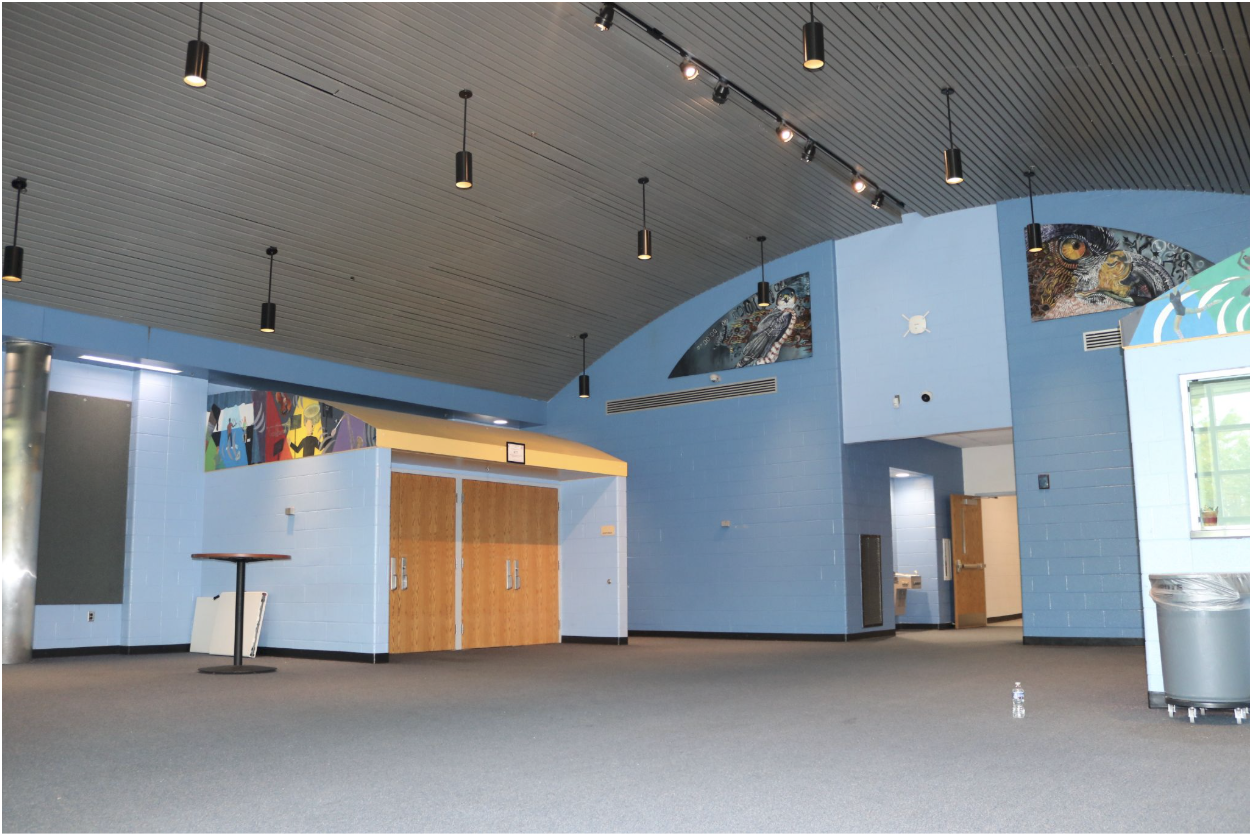
Recently, River Hill High School administration has closed the theatre lobby, affectionately known as the “Blue Room,” to students after school. In the past, the Blue Room was a social place for hours after the school day ended, as kids did homework, waited for rides, stretched after practice and caught up on gossip. Then, one day, an announcement came over the loudspeakers, directing students out of the building unless directly supervised by staff or coaches. Now, the place is deserted. A few lonely backpacks sit in corners, and lively chatter has been replaced by an engrossing silence.
Maxwell Nezu, a sophomore at River Hill, is frustrated. “I come to the Blue Room every day after school, hoping my friends are there. There is never anybody there.”
All across the county, school administrators have cracked down on unsupervised activities within the school building after classes are over. A series of events at Howard High School brought light to the fact that unsupervised students hanging out after school posed a liability.
Dr. DiFato explains, “The best practice is doing an audit of procedures and practices— and the procedure is that students must always be sponsored at all times after school. We realize that wasn’t the practice. It was a good time for us to address that. We are working with coaches, sponsors, and advisors to ensure that students are supervised at all times after school.”
He went on to say, “In walking around we noticed that there are a lot of kids walking around unsupervised. It could be a liability.”
What happened at Howard? Administrators have refrained from commenting. However, according to the Baltimore Sun, a Howard high school JV football player was repeatedly targeted in bullying incidents during the football team’s unsupervised time in the locker room.
David Leydyard, the attorney representing the athlete’s family, says that “The school should be held accountable for this environment where you leave these kids unsupervised for this period of time… and you have numerous instances of bullying happening before this main incident.”
Superintendent Bill Barnes instructed administration across the county to “revisit the expectations and procedures provided,” and to “remain diligent throughout the school year to ensure students are protected whenever they participate in school-sponsored activities.”
What do students do with their time now? Nezu says that without a community place to hang out with friends, he just goes home at the end of the day. He saw the Blue Room as “a wonderful way to meet new people who you didn’t have classes with. Now that we can’t be there anymore, I can hardly talk to those people.”
Many students believe that school is as much a community center as it is a place of learning. Jordan Solomon, a sophomore at River Hill, spends much of his time at school on account of sports practices and band rehearsals. He believes that the Blue Room provided a valuable social space for students. “We need the Blue Room as a community space in order to grow and become socially able young adults. It is a place to enlarge our social circle and build a positive community.”
Additionally, we must ask ourselves if the current policy even has the intended effect. Closing the Blue Room releases the school from any kind of responsibility, but would it prevent trouble for students? Does the current policy address the underlying issues of bullying, hazing, and drug and vape use after school?
In fact, the policy may cause more harm than good. Warren Lee, a sophomore, believes that for many students, it is safer in the school than outside of it. “I was in there after a club had just finished. We were kicked out, and we had to wait outside… They don’t want us to be in school without an adult because it is ‘unsafe.’ However, it is perhaps more unsafe to be forced to wait outside with no protection whatsoever.”
Norrie Adams, a runner on the XC team, thinks the school is a relatively safe place for people to be after school. Coaches, janitors, and teachers linger just like students do. Adams maintains that while he “wasn’t particularly supervised,” he “certainly wasn’t alone… there are teachers and janitors all through the building.”
Students want to be treated like mature young adults. When their room in which to socialize, their place of free and open discussion, their pit stop in between activities or refuge after practice, their Blue Room, is taken from them, with little to no explanation, they are understandably upset. Sophomore Vincent Lee was shocked to learn what had happened. He says, “I don’t know why they would do that. It was not well communicated.”
Student response these last few weeks has been muted. Nezu says he is upset with how students aren’t bringing more attention to this. “I’m sad that there is nobody taking a stand.” He went on to add, “I miss the days when I had a packed Blue Room to look forward to after school.”
So what is next for the Blue Room? Will things ever be the same again? Administrators say this is very unlikely.
Obviously, allowing students free run of the whole school is rife with risk. Could the school provide supervision just for the Blue Room in order to accommodate students’ desire for a social space? Solomon has suggested that, in the future, supervision of solely the theatre lobby, and subsequently allowing students back in, would be a much needed step in the right direction.
Until then, though, the memory of the Blue Room will endure. Hundreds of students here at River Hill have it to thank for shelter from the rain and sun and snow, for friendships formed and secrets spilled. Its signature blue walls have supported countless students in ways large and small. There is no place in the school so influential, or so well known. May it rest in peace.