By Jonathan Sager, Staff Writer
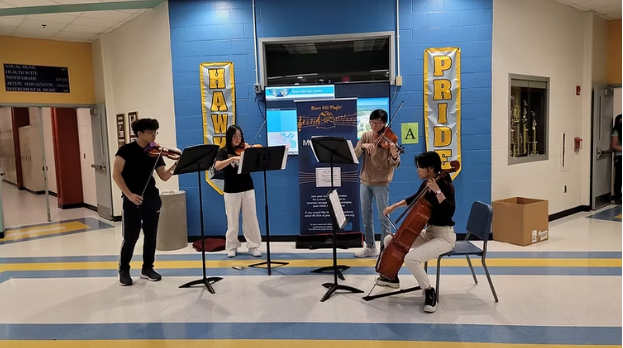
River Hill contains many different avenues for artistically and musically inclined students to express their talents, such as the band, choir or theater departments.. One of the less widely known organizations that does not get as much time in the spotlight as the band at River Hill is the school is the River Hill Orchestra.
At River Hill, there are three orchestras, which are broken down by seniority and skill level. First there is the string ensemble made up of mostly freshmen. This orchestra serves as a more beginner-friendly orchestra for members just starting out playing orchestral music in high school. For intermediate players, there is the string orchestra which plays more difficult pieces .For the most advanced orchestral musicians, there is the G/T string orchestra, an orchestra made up of mostly upperclassmen that plays the most difficult music River Hill has to offer including faster tempos and more difficult intonation.
The orchestra is usually divided into three different instruments. The violins which are the most popular and numerous instruments in the orchestra. The violins are typically divided into two sections, violin one and violin two. The violins are the instruments that can reach the highest notes and are usually the instruments that play the main melody of a piece. Accompanying the violins are the viola and cello. The role of these instruments is to support the violins by playing lower notes that the violins cannot reach. Finally there is the double bass which acts as the foundation for all the music in the orchestra. Junior Max Weimar explains one key difference between the instruments. “Compared to the violin and viola which are played on the shoulder, the cello and bass are played upright.” Weimar also explains how “the purpose of all of the different instruments is to make sure the orchestra has full sound with all ranges and pitches.”
The orchestra’s next concert is on Monday, May 13. Junior Aiden Jordan describes each piece that the G/T orchestra will be performing. “We’re playing ‘Mango’ from West Side Story, which is a very rhythmic Latin piece. We’re playing meditation, which is a very slow, quiet, nice piece. And then we’re also playing ‘March of the Scaffold’ from Symphony Fantastique, which has a lot of different elements” Jordan explains.
Jordan plays double bass in the G/T orchestra and remarks how his instrument can be challenging to play since “it’s very large, and it can be hard to control your tone and sound, and balance that with your volume.” Specifically during some of their pieces the orchestra can sometimes “face a lot of rhythmic challenges, and we have to play very slow to get it right before we speed it up,” Jordan explains. Despite these challenges, Jordan observes that the orchestra has become “a lot more comfortable playing as a unit.”
The orchestra also participates in activities outside of the classroom. In past years, students have participated in “morning serenades” in which students would perform pieces for students as they arrive at school in the morning. The orchestra also embarks on trips. Last year the orchestra took a trip to Chicago during the spring to get a chance to perform in the city and to explore the city, visiting unique sites such as the notorious Bean, The Museum of Art and the Adler Planetarium. One exhibit that stood out in particular was the miniature exhibit in which rooms were scaled down to fit inside glass boxes. Jordan recounts how “the miniatures at the art museum were really cool, it was interesting to see how realistic rooms were scaled down but still looked detailed.”
While the big trips the orchestra embarks on are fun, the music is the focus in the orchestra. As such the members of the orchestra have been working hard every day to practice their craft and are looking forward to their next concert on the 13th.