By Layla Abukhdeir, Staff Writer
When four River Hill High School students signed up for HOSA’s Medical Innovation competition, none of them had much experience with coding, engineering or electrical design. But that didn’t stop them from building a fully functioning arthritis detection device, and becoming national finalists in the process.
HOSA, Health Occupations Students of America, is a competition-based club offered at River Hill, in which students compete in different health-related categories.
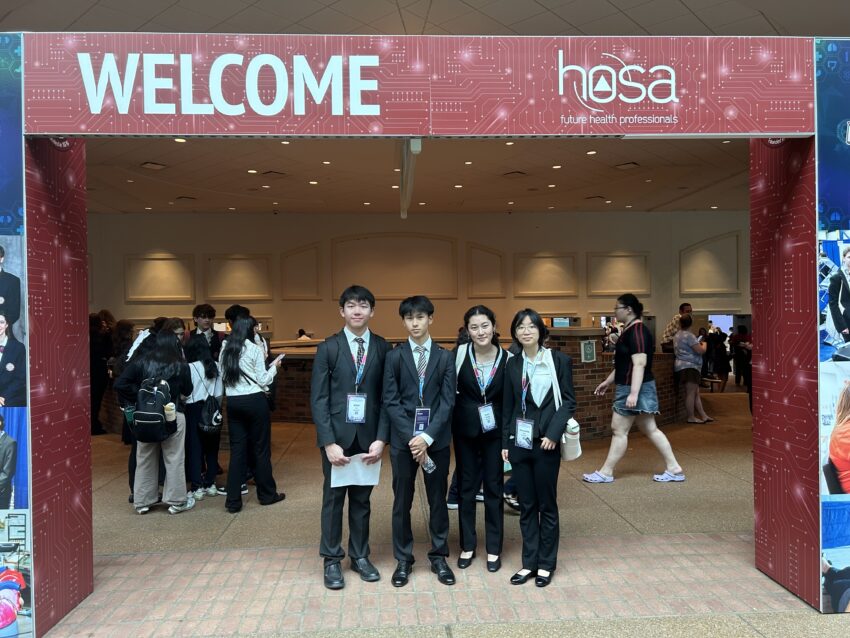
This past summer, juniors Zachary Pan, Annabelle Wu, Surie Zhang and Brian Lu represented our school at the HOSA International Leadership Conference in Nashville, Tennessee, where their team was named finalists in the Medical Innovation category.
The project? A student-engineered, 3D-printed medical device called “The Right Angle,” designed to detect early signs of arthritis and joint deterioration. The device measures force and range of motion in a user’s joints, using a sensor and is connected to a website so users can track changes over time. This device allows athletes, musicians or patients to monitor their performance and see if there is a medical issue or not.
“The idea for an arthritis detection device came from Brian,” Zhang says. “I’m not quite sure where he got it from but he proposed it at the table and Zach liked it very much. Annabelle and I, on the other hand, had to be convinced. The whole idea has definitely gone through some phases, but the original one Brian proposed is quite similar to the one we ended up working with.”
The team split the responsibilities of the project, with Wu being in charge of the website, Pan being in charge of the device itself, Zhang being in charge of the poster to present the device and Lu helping with everything—the poster, the device and the website.
Despite their lack of experience, the team taught themselves how to wire the device and write the code using YouTube videos, AI tools and even help from Pan’s father, an engineer.
“None of us had ever worked with circuits before,” Pan laughed, “but we just asked AI how to wire things safely and hoped it didn’t explode.”
Their hard work paid off. After months of brainstorming, coding, designing, and building, most of which happened in bursts between AP exams and late-night Chick-fil-A work sessions, the team submitted their final version to the national HOSA competition in Nashville, Tennessee.
“I thought the competition was a great experience since we got to travel out of state and meet new people,” Wu recounted. “For our team, the first part of the competition went alright and without many hiccups, but we had a slight device malfunction during the finals round. Regardless, we learned a lot from this event.”
Despite the device malfunction, the team still places among the top 20 finalists out of roughly 60 national teams.
“I believe the competition went well, but there are areas in which we could have improved,” Lu says. “We spent a lot of time refining and working on the innovation such that our presentation was slightly lacking. However, I am still proud of what we accomplished and hope to do even better this year.”
The team will not be presenting The Right Angle again in the 2026 competition, as one of the requirements in the Medical Innovations category is that the device be made at most a year prior to the event.